The History Beneath My Feet | Discovering Čardačani
What happened when I began investigating the largely forgotten history of the Bosnian village I have called home for almost twenty-four years.
The History Beneath My Feet
There are places we travel to because they are famous, and then there are the places we simply call home.
I have lived in Čardačani, a small village outside Laktaši in northern Bosnia and Herzegovina, for almost twenty-four years. I have walked these lanes in sunshine, snow and summer heat. I have watched the River Turjanica shrink during drought and listened to the Vrbas Valley waking at dawn.
Yet recently I realised something uncomfortable: I knew remarkably little about the history beneath my own feet.
Čardačani does not appear in many guidebooks. There is no castle, museum or famous monument. At first glance, it is simply a quiet farming village. But once I began looking through old records and local histories, a richer story started to emerge.
A Landscape Shaped by Movement
The wider Vrbas Valley has connected people for centuries. During Roman times, important routes passed through this region, although whether a Roman road crossed the modern village remains uncertain.
Even the name Čardačani may preserve a fragment of the past. It is thought to be connected to the Turkish word “çardak”, meaning a raised timber building, lookout or fortified house.
Nobody can say with certainty whether such a structure once stood here, but the name may preserve something the landscape no longer reveals.
By the time Austria-Hungary occupied Bosnia and Herzegovina in 1878, Čardačani was already an established Orthodox farming community. Census records indicate just over 200 residents during the late nineteenth century.
New Neighbours in the Valley
The surrounding countryside was changing rapidly.
The Austro-Hungarian authorities encouraged families from across the empire to settle on farmland in Lijevče polje. Italians settled around Mahovljani, German-speaking communities developed near present-day Aleksandrovac and Nova Topola, and other families arrived from Poland, Ukraine and elsewhere in the Habsburg lands.
Čardačani remained largely agricultural and Orthodox, but its neighbours increasingly spoke different languages, followed different customs and worshipped in different churches.
I often wonder how those changes appeared to the families already living here.
By the early twentieth century, the village reportedly had its own church, school, agricultural cooperative and cultural societies. It was not simply a scattering of houses. It was a community with institutions, traditions and a clear local identity.
War Beside the River Vrbas
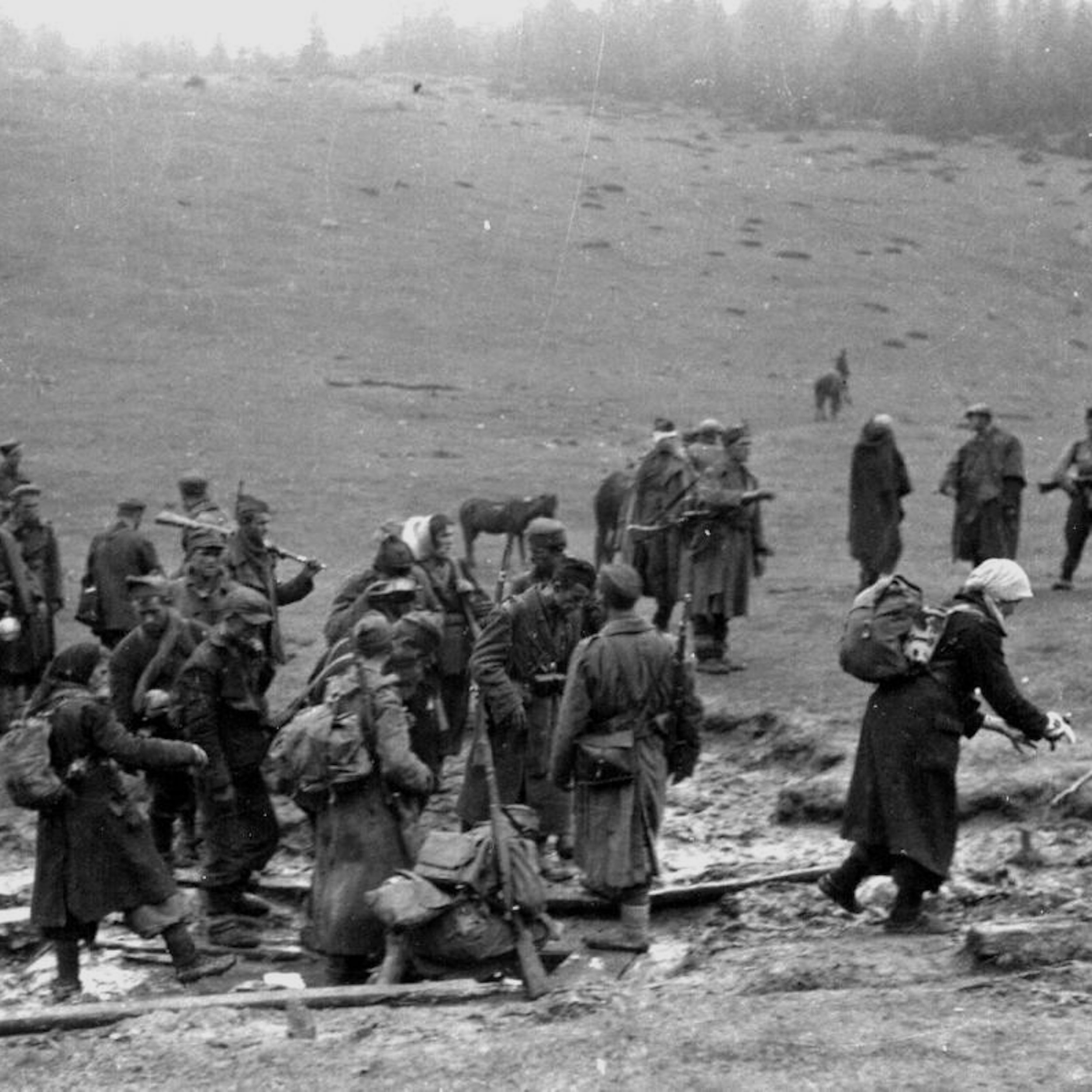
The Second World War brought that local world into a much larger conflict.
The bridge at nearby Klašnica became strategically important because it controlled movement across the River Vrbas. Military accounts describe fierce fighting around the crossing in January 1943.
Partisan forces attacked repeatedly, while the bridge was defended at different stages by Home Guard troops, Chetnik forces and German-supported reinforcements.
That fighting took place only a short distance from my home.
Local history also records that the village school was bombed during the war, although I have not yet established exactly when it happened or which forces were responsible.
This was not simply a battlefield on a military map. It was a village where ordinary families experienced the war in very different ways. Some joined the Partisans, others served with the Chetniks, and civilians were caught between armed groups and shifting front lines.
The Beginning of a Journey
There are old houses close to Klašnica Bridge that may have witnessed some of these events. There are field names that may date back generations, and memories held by older residents that have never been written down.
This episode is not the final history of Čardačani. It is the beginning of a journey.
Over the coming months, I hope to explore old maps, speak with local people and walk these familiar lanes with fresh eyes.
If your family has memories, documents or photographs connected with Čardačani, Klašnica or the neighbouring villages, I would genuinely love to hear from you.
Sometimes the most fascinating history is not found in famous cities or grand museums.
Sometimes it is waiting quietly beneath our own feet.