Four Days, Two Visitors and a Very Full Introduction to Bosnia.
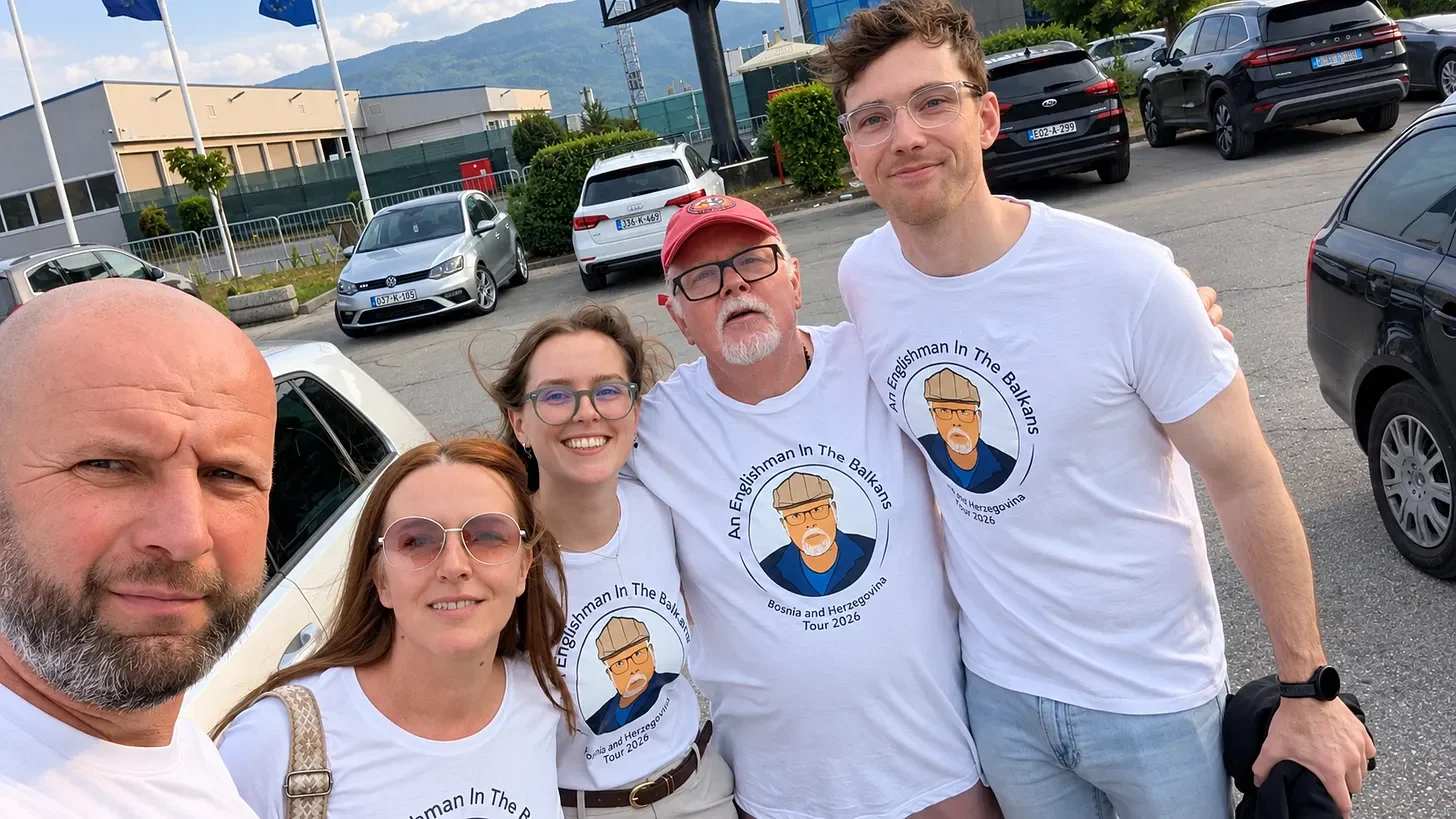
Senad, Tamara, Emma, Me, Sam
From a misty night in Lukomir to rakija in a village garden, followed by a rapid return to teaching on Mount Igman.
I’m writing this on a warm and surprisingly sunny Thursday afternoon on Mount Igman, just outside Sarajevo.
Igman was one of the locations used during the 1984 Winter Olympics. These days, away from the ski season, it is a quiet place of wooded slopes, mountain air and the occasional reminder that Sarajevo is not very far away.
I’m here teaching on a crisis communications course. It has been a good week, although it came immediately after four rather full days showing my nephew Sam and his girlfriend Emma a small corner of Bosnia and Herzegovina.
That is also why there was no Sunday Edition last weekend.
There simply wasn’t time.
A four-day introduction to Bosnia
Sam and Emma had come across from the UK for what we began calling their “micro-introduction” to Bosnia and Herzegovina.
Trying to introduce anyone to this country in four days is, of course, slightly ridiculous.
Where do you begin?
With the mountains? The cities? The food? The history? The villages? The coffee? The people?
In our case, we began almost immediately after they landed at Sarajevo Airport.
Tamara and I had designed some rather splendid tour T-shirts for the occasion. Once those were on, we climbed into our friend Senad’s four-wheel drive and headed towards Lukomir.
Lukomir is often described as Bosnia’s most remote village. I had visited twice before, but arriving there on a misty evening felt completely different.
The clouds had settled around the mountains. The village seemed cut off from everything beyond the stone houses, steep roofs and surrounding landscape.
We stayed overnight in a local family home, where we were given a traditional dinner and a warm welcome.
For Emma in particular, it was a completely new experience. A different landscape, a different rhythm of life and a culture she had previously known very little about.
I think she was slightly blown away by it all.
The following morning was extremely windy. Any thoughts I had of flying the drone quickly disappeared. There was absolutely no chance of putting it into the air without watching it vanish somewhere towards Montenegro.
We did manage to reach several viewpoints, looking across the mountains and down into the canyon far below.
At least, most of us reached them.
Senad was temporarily missing because one of the tyres on his four-wheel drive had blown. For a short while, we wondered whether we might be stuck on the mountain.
Fortunately, Senad is rather good at dealing with mechanical problems in remote places. It takes more than a damaged tyre to stop him.
From Lukomir, we travelled on to Prokoško Lake.
It meant several more hours on the road, but the journey was worthwhile. The lake sits high in the mountains, surrounded by small wooden houses and a landscape that seems a long way from the modern world.
It is one of those places I would happily recommend to anyone visiting Bosnia and Herzegovina, although, as with many mountain locations here, the journey is very much part of the experience.
A different sort of Bosnia
From there, we continued towards Zenica and our hiking club.
That introduced Sam and Emma to another side of life here.
There was plenty of food, a few drinks, long conversations, music, singing and dancing. In other words, a fairly typical evening whenever our hiking friends get together.
There are some things that are difficult to explain to visitors in advance.
You can tell people that hospitality is important here. You can describe the amount of food likely to appear on a table. You can warn them that an evening may continue for rather longer than expected.
But they have to experience it for themselves.
By the time we returned to Čardačani, I think we were all beginning to feel the pace.
We slowed things down and took a walk around our village.
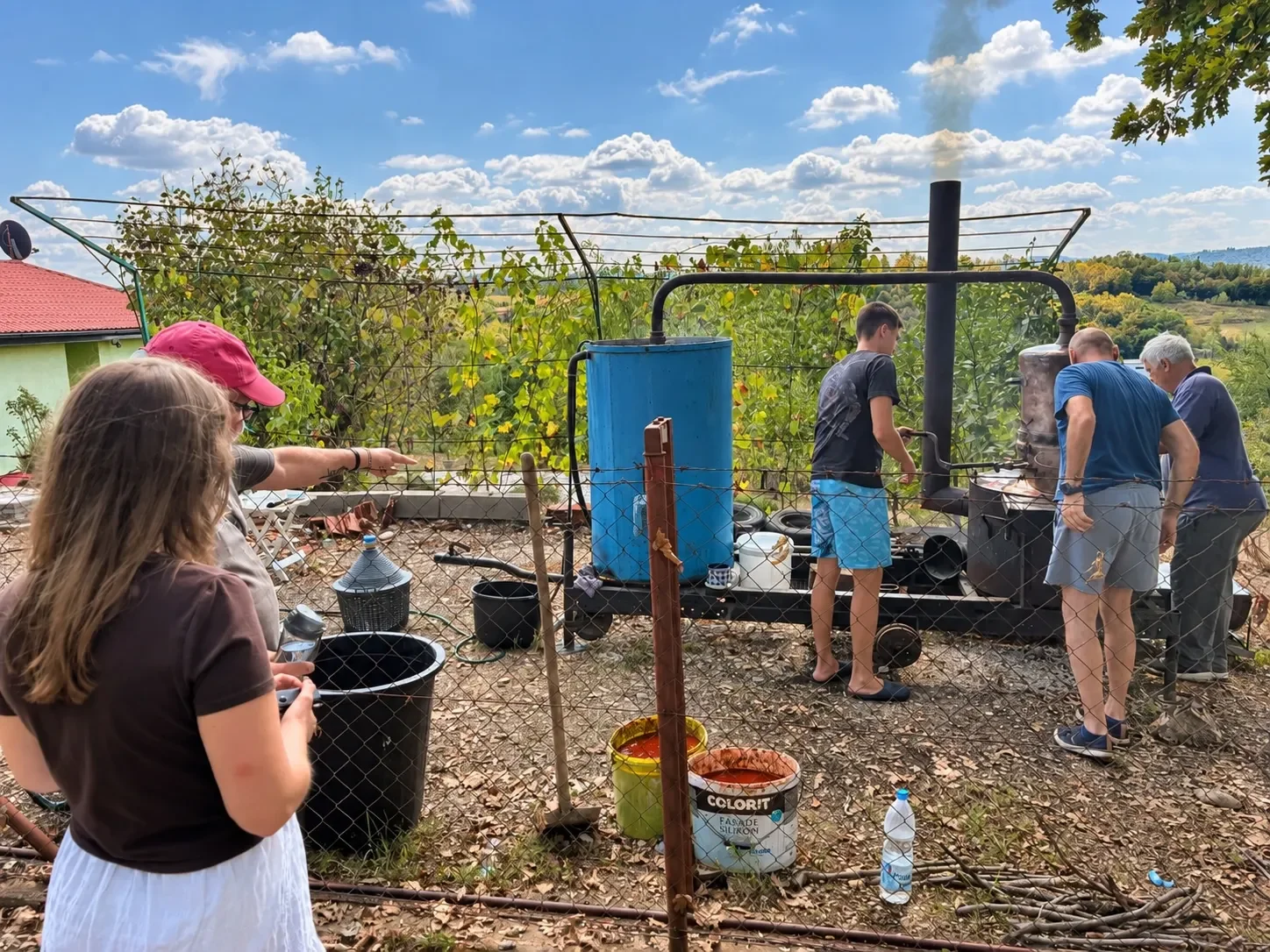
Rakija is normally made a little later in the autumn, often during October and November. But as we walked past one of the local houses, a family had already begun distilling fruit in their garden.
People here often say that they are “baking” rakija. I still tend to say they are making it.
Whatever expression you use, Sam and Emma were able to watch fruit being turned into brandy in someone’s garden.
There were explanations, photographs and, naturally, some sampling.
You cannot really plan moments like that. They simply happen.
And quite often, those unexpected encounters become the things visitors remember most clearly.
A day in Banja Luka
Our final full day took us into Banja Luka.
We walked through the city, visited the large Serbian Orthodox cathedral in the centre and then went inside the Ferhadija Mosque.
I’m not sure whether Emma had ever visited a mosque before, but both she and Sam were impressed by the building and its atmosphere.
Banja Luka sometimes surprises people.
Its centre is compact enough to explore on foot, but within a relatively small area there are layers of history, religion, architecture and memory.
As with so much of Bosnia and Herzegovina, you only begin to understand the place when you slow down and look beyond the surface.
And then, almost as quickly as the visit had begun, it was over.
Departures and another mountain
Early on Monday morning, we took Sam and Emma to the bus station in Banja Luka.
They caught the 7.30 bus to Zagreb, from where they would fly back to the UK.
Fifteen minutes after waving goodbye, I was already travelling in the opposite direction towards Sarajevo and Mount Igman.
There was no gentle pause between our miniature tour and the working week.
The crisis communications course finishes on Friday. After that, I’ll make my way into Sarajevo, find a bus and meet Senad once again.
We will be heading back towards our hiking club near Zenica for a remembrance walk in honour of a former club member.
There will be a walk on Saturday, followed by a barbecue and all the conversation and socialising that normally goes with these gatherings.
Tamara will be travelling down from Banja Luka with her father, and at some point we will all hopefully manage to meet in the same place.
Then, on Sunday, the day you are reading this, we will begin making our way back to Čardačani.
Normal service, or something resembling it, should resume next week.
Closing in on a milestone
One final piece of good news.
The podcast continues to grow steadily and is now closing in on 1,000 downloads since the relaunch on 23 June, with more than 590 unique listeners.
Those may not be enormous numbers in the wider podcasting world, but they mean a great deal to me.
Each number represents someone who chose to stop, listen and spend a little time with these stories from Bosnia and Herzegovina.
That is all I ever really wanted the podcast to do.
Thank you for reading and following along.
And if someone you know might enjoy these stories, please consider forwarding this Sunday Edition to them. Personal recommendations remain the best way for an independent podcast and newsletter like this to grow.
Until next Sunday,
Vidimo se,
David