Brown Grass, Bats and Bob’s Your Uncle
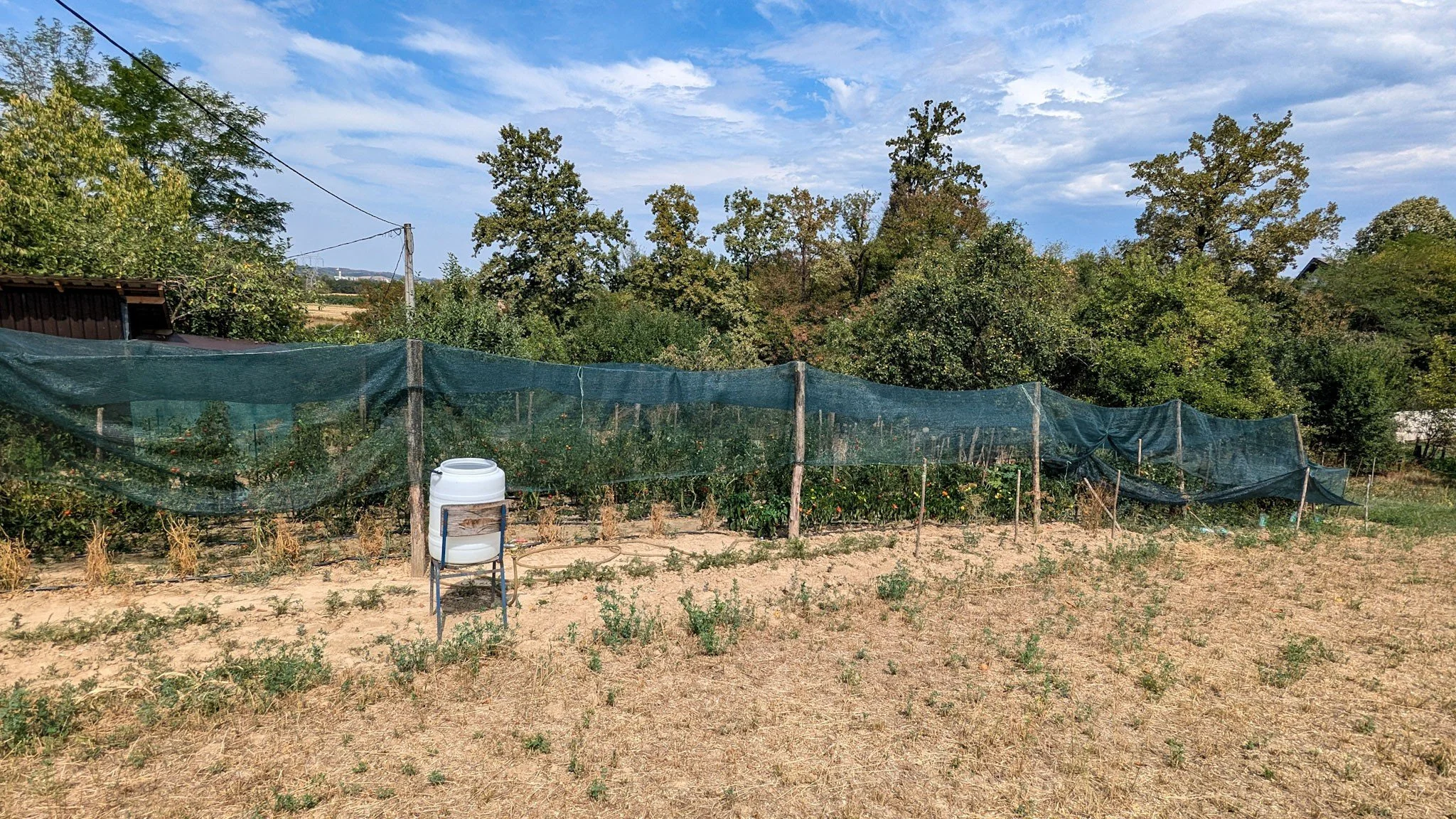
This morning I’m writing, or rather, thinking, from the upstairs garden.
It’s half past ten and already 32°C.
Apparently we’re heading back towards 37 or 38 later, and the garden is beginning to show it. The grass has almost completely disappeared into various shades of brown. Some of the bushes are looking rather sorry for themselves too.
There is still green in the trees, thankfully.
And Tamara’s parents’ kitchen garden is hanging on.
I can see red peppers, feferoni, those little peppers which, if you get the wrong one, can produce a rather memorable experience at the other end.
“In England we call that “Ghandi’s Revenge”.
The tomatoes are still there too, protected beneath green anti-UV netting.
There’s even a ladder leaning against a cherry tree a few hundred metres away.
Quite why it’s still there I don’t know. Surely nobody is finding cherries at this stage.
We’ve had a couple of downpours recently, but nothing that has really changed things.
And, of course, the irony is that when the serious rain eventually comes, we’ll probably go from worrying about drought to worrying about flooding.
That seems to be the way of things.
Looking across the valley
We live on the side of a hill, so flooding isn’t something we personally have to worry about too much.
At the top of the garden there’s usually a wonderful view across Laktaši and the countryside beyond.
At this time of year the leaves obscure quite a lot of it, but once autumn arrives you can see for miles.
On the far ridge there’s a white church.
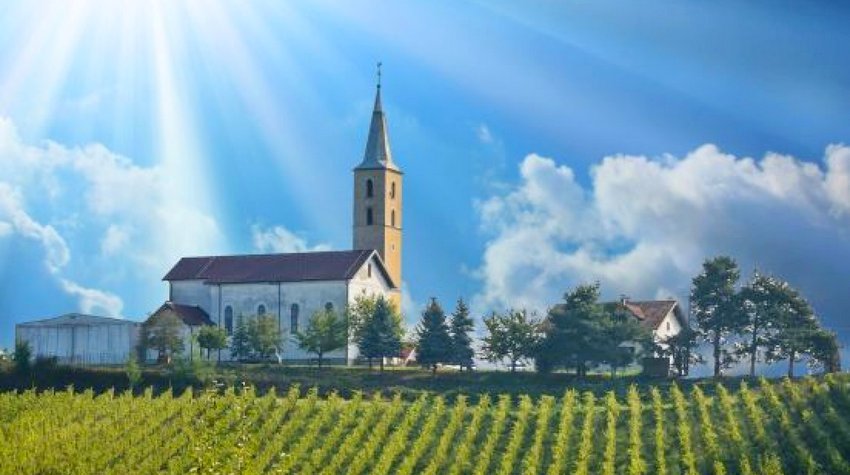
The Church of St Francis of Assisi.
That part of the countryside has an interesting story attached to it. In the late 19th and early 20th centuries, under Austro-Hungarian rule, Italian settlers established a colony there. There were other colonies around this part of Bosnia too.
That’s a story I want to explore properly for the podcast sometime.
One of the lovely things about living here for so long is that there are still stories sitting almost within eyesight of the house that I’ve never properly investigated.
Summer has changed our days
At the moment, our days are being organised around the temperature.
Tamara and I sit outside at about seven in the morning with coffee and have a chat. That’s one of the nicest parts of the day. Then we more or less retreat into the house. Blinds down, AC on.
The next time we’ll spend any real time outside is seven or eight in the evening, usually at the back of the house where a breeze comes through.
The crickets in the evening are deafening. Some people find them irritating. I rather like them.
And then there are the bats.
I’ve become strangely fascinated by watching bats in the evening. I know very little about them, which probably means another rabbit hole is approaching.
But I have to admit that this summer heat is beginning to take its toll.
For perhaps the first time I’m starting to think:
Ah. Maybe I really am getting older.
Although there are still plums hanging above my head as I write this.
So I shouldn’t complain too much.
A small podcast milestone
The podcast continues to quietly surprise me.
An Englishman in the Balkans now has more than 460 unique listeners since I relaunched it on 23 June. In reality, I suspect the genuinely regular audience is somewhere around 60, 80, perhaps 100 people.
And I’m perfectly happy with that.
I do almost no marketing. I probably should. But I cannot bring myself to spend my days shouting into the internet using excitable words, CAPITAL LETTERS and promises that something will CHANGE YOUR LIFE.
It’s just not me. I would rather make something good and hope that, slowly, people who enjoy it tell someone else.
One thing I have been doing is revisiting a few older conversations.
This week I’ve been working again with an interview I recorded with Ivana, who now lives on Australia’s Gold Coast.

She was six years old when her family fled their village outside Zenica during the war in the 1990s.
At one point they escaped through the woods, having to avoid minefields. Years later she returned to Bosnia and walked that route again.
Imagine doing that. Six years old when you first make the journey in fear, then returning as an adult to walk the same ground.
I think it’s a remarkable story.
I’ll put the episode below for you.
If you don’t use Spotify then click below for the podcatcher of your choice 👇
But then there is the internet
I contacted Ivana to ask if she minded me putting the conversation out again.
Of course she didn’t. But our conversation then went somewhere else.
She showed me some of the comments she receives online.
And they were vile. Not criticism. Not disagreement. Just hatred.
Ivana is a Bosnian Croat. She tells her own story, from her own experience.
Yet apparently even that is enough for complete strangers, some in Croatia, some elsewhere in the world, to decide they have the right to abuse her.
It made me wonder again:
Who are these people?
I genuinely mean that. Are these people we meet in ordinary life? Do they sit beside us in cafés? Do they laugh at parties, help neighbours, hold doors open for people, then go home and become somebody completely different behind a screen?
Ivana told me the negativity sometimes makes her consider giving up her online work altogether.
I told her not to.
Block them.
That’s my approach these days.
If someone arrives simply to be unpleasant, they lose the privilege of being part of my little corner of the internet. No debate. No argument. No clever comeback.
Gone.
I’ve also found that if somebody genuinely wants to tell me something, they’ll often take the time to send an email. There’s something about having to sit down and actually write to another human being that removes a lot of the casual nastiness.
I’d genuinely be interested in your thoughts.
Why do you think people behave so differently online?
You can reply directly to this newsletter.
Back to walking
I haven’t really walked since last week.
I’ve had a small physical niggle and didn’t want to aggravate it, but I’m beginning to feel that sitting around isn’t helping either. So I’m considering a new routine.
Up at six. Out while it’s still cool. Nothing heroic.
Two kilometres out. Two kilometres back.
Mostly flat.
Home, shower, coffee. Then start the day.
At 73 I’m still young.
Right?
There’s a reason for getting some walking back into my legs too.
On 19 September, Tamara, some friends from our hiking club and I are planning to climb Mount Hum. I’d very much like to do it. But I’m also beginning to reconsider what sort of walking I actually enjoy.
Perhaps I’m becoming a flat walker.
Is that a thing?
Rather than climbing simply to reach a summit, I like the idea of walking further, following rivers, roads, old railway lines, villages, paths.
Seeing more rather than necessarily seeing it from higher up.
I’ve done the mountain thing. Many years ago I climbed two volcanoes in the Ecuadorian Andes. Wonderful experience.
Wouldn’t do it again though.
These days I think distance, landscape and curiosity appeal to me far more than altitude.
Visitors are coming
Next month my nephew Sam is coming over from Britain with his girlfriend.
Sam has been here several times and loves this part of the world. They were recently travelling along the Croatian coast, but this time they’re crossing to the other side of the Dinaric Alps.
They have four days with us.
I think Sam was imagining four leisurely days sitting in the garden, drinking, chatting and perhaps wandering into Banja Luka. He is mistaken. They land in Sarajevo. And the adventure begins from there.
I shall say no more for now.
And finally… King Lazar
I’ll leave you with something from Banja Luka.
There are plans for a very large statue of King Lazar to be placed on a roundabout near the beginning of King Peter Karađorđević I Street, what many older residents will remember as Tito’s boulevard.
The reported cost is around 1.5 million convertible marks. About €750,000.
I’m told the statue could be something like 24 metres high, although we’ll see what eventually appears. King Lazar, of course, is associated with the Battle of Kosovo in 1389.
And this enormous figure is apparently going into the middle of a traffic roundabout.
Some local reaction has been along the lines of: “Could we perhaps spend the money on water infrastructure instead?”
Given the summer we’ve just had, you can understand the question.
I mentioned the statue to the family and said: “You know exactly what would happen if that was in Britain.”
They looked at me blankly.
“A traffic cone would be on his head within about 48 hours.” Which then required me to explain the strange British tradition of putting traffic cones on statues.
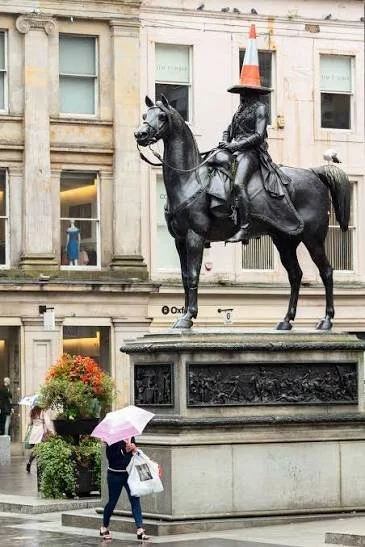
Sometimes there are cultural differences which are difficult to explain.
I think that may be one of them.
And with that, I’m heading back indoors before I cook.
Another Sunday Edition finished.
Bob’s your uncle.
And if you don’t know what that means, I’ve already had to explain it to Tamara this week.
Vidimo se.
David