Bosnia Is Beautiful, But Walk Wisely | Landmines, Memory and Respect
A Peaceful Sunday in the Village
There are days here in the village when Bosnia and Herzegovina feels as peaceful as anywhere on earth.
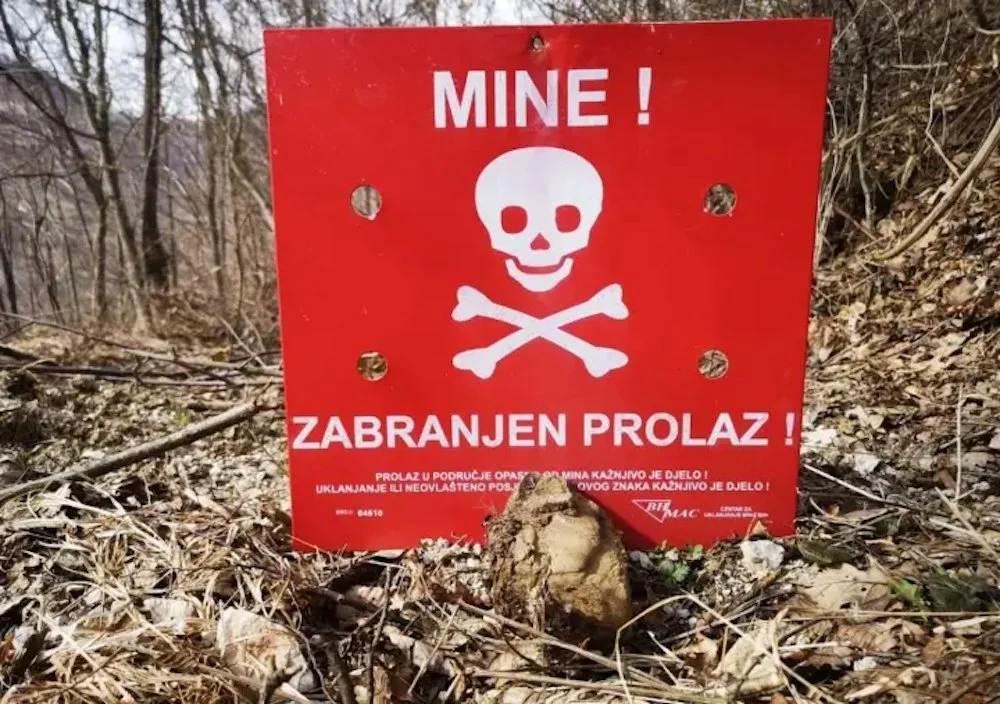
Mine Sign in a Remote location - Bosnia
Birds in the trees. Dogs wandering around the garden. The distant sound of a tractor somewhere up the lane. A warm Sunday afternoon. Coffee nearby. Ordinary life carrying on in that gentle, familiar way that makes this place feel so settled.
And that is the Bosnia I know most of the time.
A country of villages, rivers, mountains, cafés, family gatherings, markets, festivals, basketball matches, and people getting on with their lives.
The Traces Still Beneath the Surface
Every now and again, living here reminds you that Bosnia and Herzegovina still carries traces of its recent past.
Some of those traces are visible. Some are spoken about. Some are kept quietly in memory.
And some are still in the ground.
I’m talking about landmines.
Not in a dramatic way. Not to frighten anyone. And certainly not to make Bosnia sound unsafe or unwelcoming, because that would be deeply unfair.
But in 2026, landmines and explosive remnants of war are still part of the reality of Bosnia and Herzegovina. Much less than before, of course, thanks to many years of difficult and courageous work. But the problem has not disappeared.
Bosnia Is Not a Dangerous Landscape
For most people living here, daily life is completely normal.
People go to work, children go to school, farmers work their land, families travel, hikers walk, tourists visit, and cafés fill up as they always do.
Bosnia is not a dangerous landscape waiting to trap the unwary.
But it is a country where you need to pay attention.
A Lesson I Never Forgot
I learned that lesson very personally more than twenty years ago.
Tamara and I had gone away for a night to a mountain lodge. The weather was beautiful. The food had been good. The morning felt perfect for a walk. So we set off along a path, enjoying the forest and the quiet.
Then I noticed flowers growing up among the trees.
“Let’s go and have a look,” I thought.
And so, hand in hand, we walked up the hillside.
Then, all at once, one of us said the word neither of us wanted to hear.
“Mines.”
At the time, Tamara was working for an international organisation and I was working with NATO. We both knew the risks. We both knew to check mine maps. We both knew better.
And yet, for a few careless moments, we had forgotten.
The short walk back down that hillside felt endless. Every step was slow. Careful. Deliberate. By the time we reached the asphalt road again, we both knew how foolish we had been.
It was a lesson I have never forgotten.
Curiosity Needs a Second Question
Here in Bosnia, the innocent question, “I wonder where that path goes?” sometimes needs a second question.
“Is it safe?”
That does not mean walking around in fear. It means walking with respect.
Stick to marked trails. Listen to local people. Stay with hiking groups. Take warning signs seriously. Do not wander into abandoned buildings, overgrown land, remote woodland, or areas that clearly have not been touched for years.
Do Not Rely Entirely on Your Phone
Mine maps and apps are useful, and official resources from BH MAC and EUFOR are important. But no app is a magic shield.
Mobile signals disappear. Signs can be damaged. Floods can move dangerous objects. Nature can hide the evidence of war very quickly.
The safest advice is still the simplest.
Stay on known paths. Ask locally. Follow signs. Do not touch anything suspicious. And when in doubt, turn back.
Why This Matters for Visitors
This matters especially now because more people are discovering Bosnia and Herzegovina for hiking, cycling, road trips, photography, drone filming, and slow travel.
I understand that completely.
Bosnia invites curiosity.
A track disappears into the trees and you want to follow it.
A ruined building catches your eye.
A hilltop promises a wonderful view.
But curiosity here needs to be balanced with local knowledge.
Come to Bosnia, But Come With Respect
That is not a reason to avoid Bosnia. Quite the opposite.
Come here. Drink coffee by the river. Walk through old towns. Visit villages. Explore the mountains with people who know them. Sit in cafés. Listen to stories.
Discover why so many of us feel such affection for this country.
Just come with respect.
Peace Is Patient Work
Peace is not only the absence of war.
Sometimes peace is the slow, patient work of making land safe again, field by field, path by path, village by village.
Bosnia and Herzegovina is beautiful.
But like many beautiful places, it asks us to pay attention.