Two Schools Under One Roof
How Education Still Divides Bosnia and Herzegovina
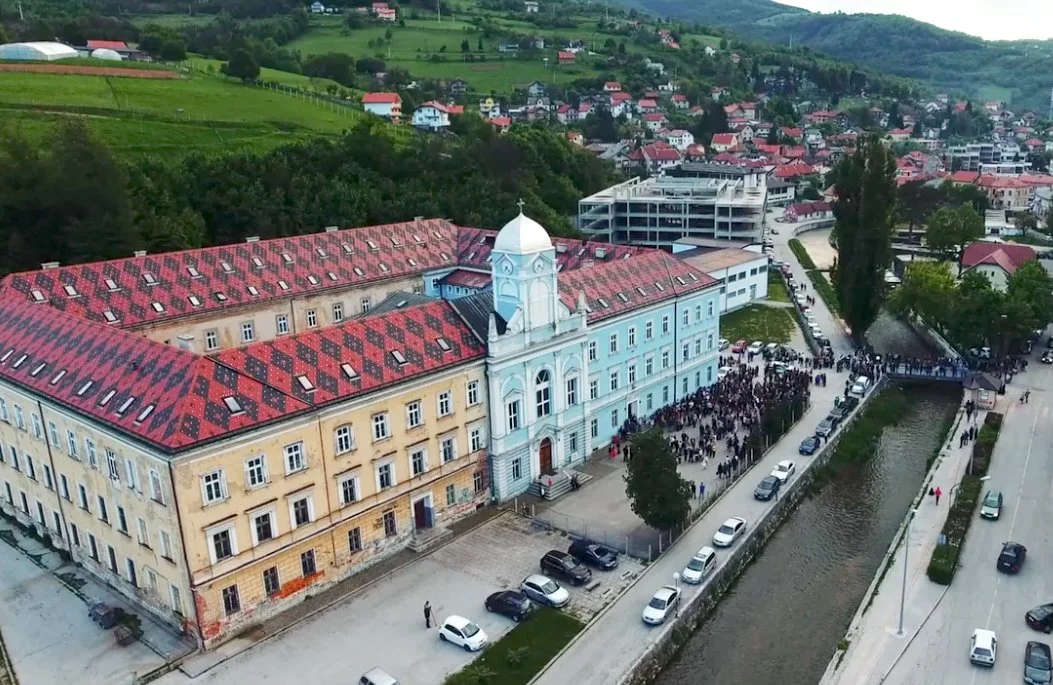
Travnik in middle Bosnia. The Brown side is for Bošniaks (Muslims) the Blue is for Croats (Catholics)
A Country That Cannot Be Understood Quickly
One of the things I have learned during more than 25 years of living in Bosnia and Herzegovina is that this is not a country you can understand quickly.
The landscapes are beautiful, the hospitality is genuine, and people are often extraordinarily welcoming. Yet beneath everyday life lies a history that still influences how the country works. Sometimes that history appears in politics or memorials. Sometimes it appears in something as ordinary, and as important, as a school.
I am not an education expert. I am simply someone who has lived here for a long time and continues to ask questions about the country I now call home.
When Children Learn Together
When I arrived in Bosnia and Herzegovina in 1998, I assumed schools would work much as they did in Britain. Children would attend their local school, learn together and grow up knowing one another.
In many parts of the country, that is broadly what happens. Here in Republika Srpska, where I live, pupils generally attend the same public schools rather than being separated within one building according to ethnicity or religion. There are also faith-based schools in Banja Luka which families may choose to attend.
Elsewhere, particularly in parts of the Federation of Bosnia and Herzegovina, the picture can be very different.
What Does “Two Schools Under One Roof” Mean?
The phrase “two schools under one roof” sounds like a metaphor. In reality, it can be quite literal.
After the war of the 1990s, some communities faced the challenge of rebuilding education while fear, mistrust and displacement were still very real. A temporary arrangement was introduced in a number of towns.
Children from different communities shared one school building, but often used separate entrances, classrooms, teachers and timetables. In some cases, they also studied different curricula.
At the time, this was seen by some as a practical compromise. It allowed families to feel that their language, culture and identity were being protected. Others saw it as the continuation of division by another name.
Although the number of such schools has fallen, the system has continued in several communities.
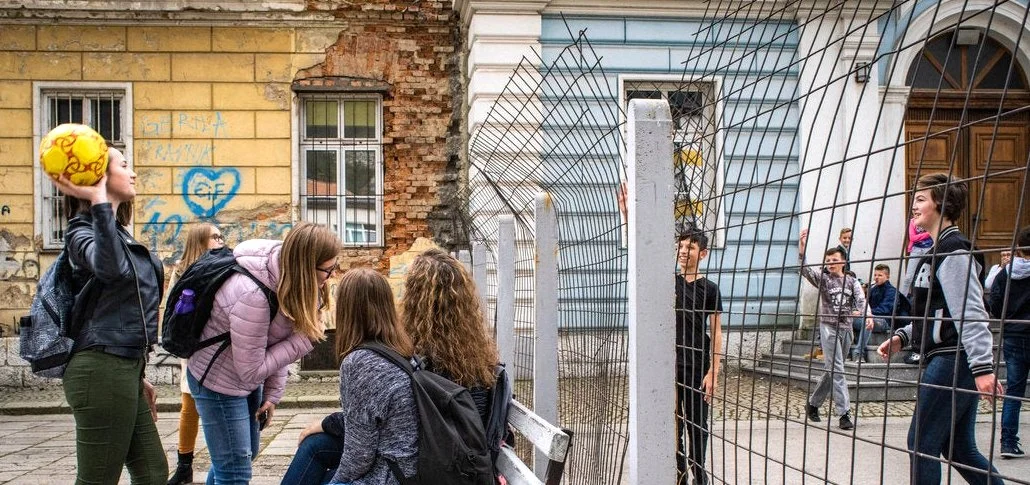
Meanwhile, in places such as Travnik, two schools under one roof ended last year, when a new school was built to accommodate Bosniaks. “Now we have two separate buildings, but it’s the same issue. We’re divided,” explains Tarik. Tarik is now a university graduate, but he remembers his experience as a student in Travnik very well.
One Country, Several Curricula
Bosnia and Herzegovina does not have one national school curriculum.
Education is organised through entities, cantons and local authorities. Children can therefore be taught different versions of history, literature, language and identity depending on where they live.
For someone arriving from outside, this can be difficult to understand. For many people who grew up here, it is simply part of the system they have always known.
International organisations have argued that more integrated education could help young people understand one another and contribute to reconciliation. Others believe separate curricula are necessary to preserve cultural identity, language and tradition.
These are deeply personal and often passionately held views.
What Kind of Country Will Children Inherit?
I do not believe it is my place, as an outsider who chose to live here, to tell people what their education system should look like.
But I do think it is reasonable to ask what kind of country today’s children are being prepared to inherit.
The pupils sitting in classrooms now will become tomorrow’s teachers, doctors, engineers, journalists, politicians and parents.
A school does more than teach mathematics or geography. It also shapes how young people understand their neighbours and imagine their place in society.
Curiosity Before Certainty
Bosnia and Herzegovina has taught me that history rarely stays in the past. It echoes through buildings, institutions, family stories and everyday conversations. It also echoes through classrooms.
After more than a quarter of a century here, I still do not pretend to have all the answers. Perhaps there are no easy answers.
But thoughtful questions matter. Listening matters. Curiosity matters.
Because understanding does not begin with certainty. It begins with being willing to look more closely.