Bosnian Superstitions | Promaja, the Evil Eye and Good Luck
Tamara and I explore the beliefs, warnings and everyday rituals that remain part of life in Bosnia and Herzegovina.
The Beliefs Hidden in Everyday Life
Living in Bosnia for more than twenty-five years has taught me that some of the most revealing parts of a culture are not found in museums or history books. They appear in ordinary conversations, family habits and warnings passed from one generation to the next.
In this episode of An Englishman in the Balkans, Tamara and I talk about Bosnian superstitions. Some are playful, some are taken seriously, and others are so deeply woven into daily life that people follow them almost without thinking.
The Great Danger of Promaja
We begin, naturally, with promaja.
Promaja is the current of air created when windows or doors are open on opposite sides of a room, house or car. To a British person, it is simply a draught. In Bosnia, it can apparently cause a stiff neck, earache, sinus trouble and, depending on who you ask, something worse.
Tamara insists that the fear of promaja is ingrained in the culture. Children grow up hearing about it, adults close car windows, and almost everyone has a relative who treats it as a genuine health hazard.
I remain sceptical, although I have learned not to sit between two open windows and argue the point.
Never Turn Back
Another belief says that returning home after setting off on a journey can bring bad luck. You may have forgotten your telephone, wallet or keys, but according to the superstition, it may be wiser to carry on without them.
Tamara remembers her mother throwing a little water behind family members before exams or important journeys. The idea is that everything should flow smoothly, like water.
The important part is not to turn around and look back.
Coins, Bread and a Successful Year
At Christmas, Tamara makes česnica, a traditional festive bread containing a hidden coin. Whoever finds it is believed to have a fortunate year ahead.
She also fills the pockets of her apron with all the money she can find while making the bread. This is meant to encourage prosperity during the coming year.
I have never found the coin in more than two decades of trying. Other members of the family seem remarkably lucky. I have occasionally wondered whether the whole thing is fixed.
The Evil Eye and Protection
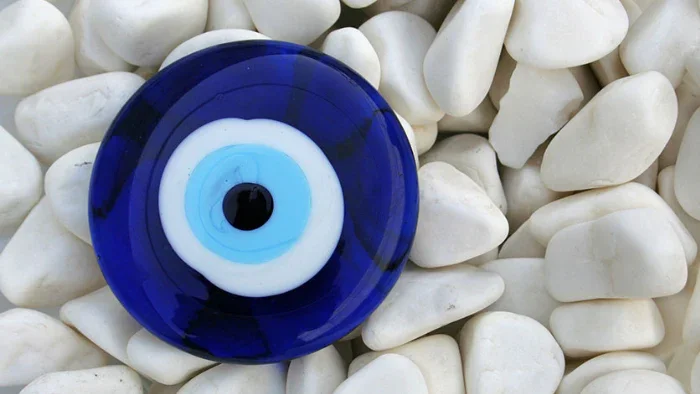
We also talk about urok, the evil eye. The belief is that an envious look or careless words can bring misfortune or illness, particularly to children.
Blue beads, glass charms and other small objects are used for protection. We have a large blue evil-eye decoration in our bedroom, brought home after a trip to Turkey. Tamara believes it catches harmful energy. I am not convinced, but I am happy to let it continue doing its work.
Small Signs and Daily Rituals
There are beliefs surrounding broken mirrors, lost wedding rings, itchy palms and even handing someone a knife or pair of scissors. Some say sharp objects should first be placed on a table, otherwise the friendship may be cut along with whatever needs cutting.
An itchy left palm may mean money is coming in. An itchy right palm suggests it may soon be going out. That superstition seems accurate most months.
More Than Old Wives’ Tales
It is easy to dismiss these customs as old-fashioned nonsense. Yet they also tell us something about family, memory and the way people try to make sense of uncertainty.
Whether we call them superstitions, traditions or rituals, they add meaning to ordinary moments. They connect the present with generations who followed the same customs before us.
Perhaps that is why they survive. Not because everyone fully believes them, but because they remain part of the rhythm, humour and cultural fabric of life in Bosnia and Herzegovina.