The Flag Nobody Could Agree On
The surprising story of how Bosnia and Herzegovina got its national flag.
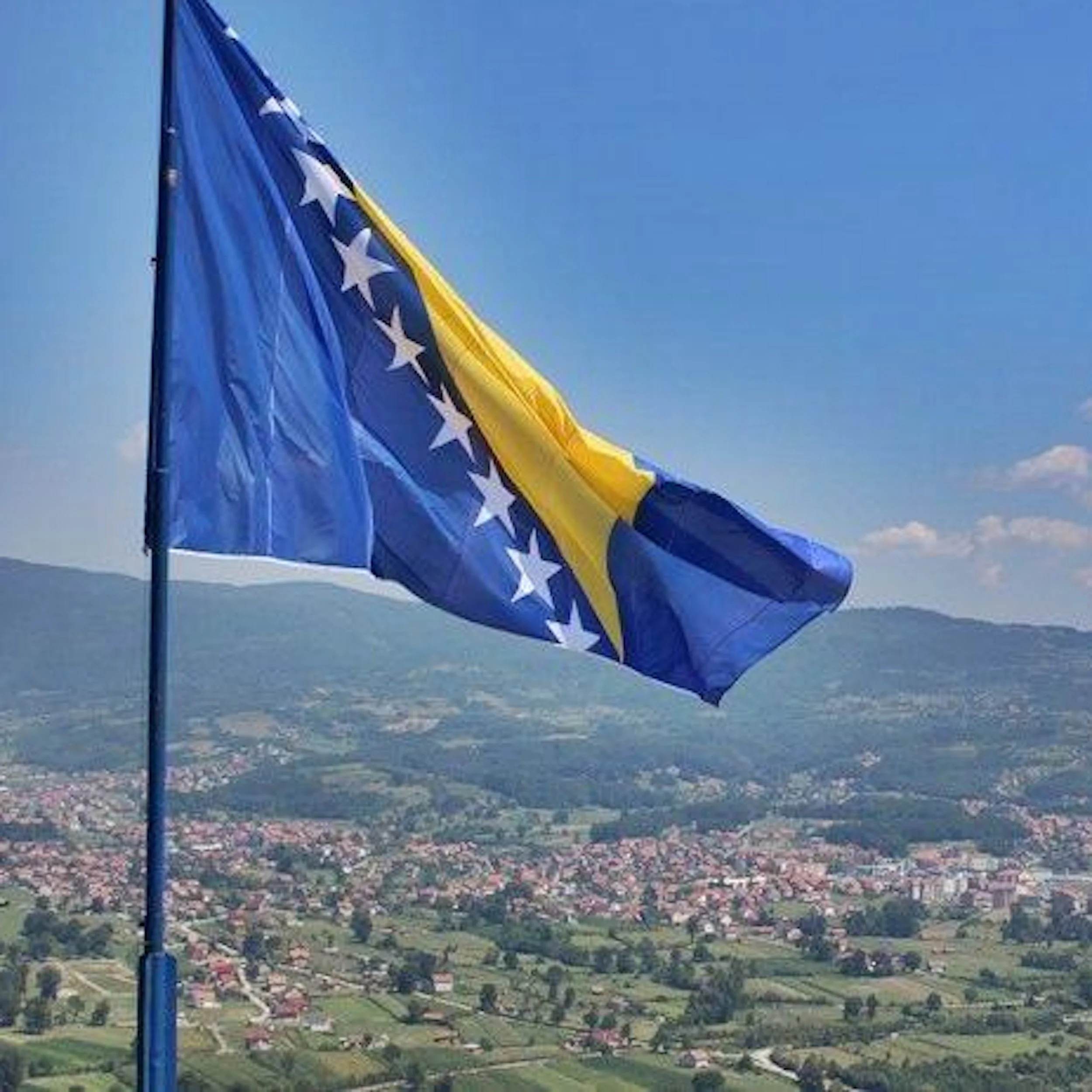
If you live in Bosnia and Herzegovina, you become so accustomed to seeing the country's blue, yellow and white flag that you probably don't give it much thought.
It flies outside government buildings, appears at border crossings and sporting events, and is displayed on everything from official documents to car number plates.
But the Bosnia and Herzegovina flag has a rather unusual story.
Unlike many national flags, it wasn't chosen because everyone agreed that its colours and symbols represented their shared history.
In fact, almost the opposite happened.
The flag exists because nobody could agree on what the country's flag should be.
Before the Blue and Yellow
When Bosnia and Herzegovina became independent in 1992, its flag looked very different.
It had a white background with a blue shield containing six golden fleurs-de-lis. The lilies drew upon the heraldry of medieval Bosnia, particularly the Kotromanić dynasty.
The intention was to connect the newly independent country with a much older period of Bosnian history.
Then came the war.
Between 1992 and 1995, the fleur-de-lis flag became closely associated with the government of the Republic of Bosnia and Herzegovina and its army.
Whatever its historical origins, by the end of the war many Bosnian Serbs and Bosnian Croats no longer regarded it as a neutral symbol representing everyone.
The Problem After Dayton
The Dayton Peace Agreement brought the war to an end in 1995 and established much of the political structure Bosnia and Herzegovina still has today.
But creating institutions was one thing.
Finding symbols everyone could accept proved considerably more difficult.
The lilies were contentious. A Serbian eagle or Croatian chequerboard clearly wasn't going to solve the problem either.
Crosses, crescents and other traditional symbols carried their own associations.
So what exactly do you put on the flag of a country where almost every obvious historical symbol means something different to different people?
By the end of 1997, there was still no agreement.
Designing a Neutral Flag
In January 1998, the Office of the High Representative established an independent commission to produce alternatives.
The brief was extraordinary when you think about it.
They needed to design a national flag while avoiding imagery that could be regarded as belonging exclusively to one of Bosnia and Herzegovina's constituent peoples.
Three designs eventually emerged.
One contained elements we recognise immediately today: a blue background, a yellow triangle and white stars.
There were no traditional ethnic or religious symbols.
That was deliberate.
What Do the Triangle and Stars Mean?
The yellow triangle is usually interpreted in two ways.
Its shape roughly echoes the outline of Bosnia and Herzegovina, while its three corners represent the country's three constituent peoples: Bosniaks, Croats and Serbs.
The white stars and blue background connect Bosnia and Herzegovina with Europe.
Look closely and you'll notice that the stars at the top and bottom are incomplete. The line appears to continue beyond the edges of the flag, suggesting an infinite sequence.
Interestingly, early versions used a much lighter shade of blue. That was later replaced with the darker European blue we know today.
A Decision Had to Be Made
The proposed flags went before Bosnia and Herzegovina's Parliamentary Assembly in February 1998.
Once again, agreement proved impossible.
And there was now a deadline.
Bosnia and Herzegovina was about to send athletes to the Winter Olympics in Nagano, Japan. The international community wanted them entering the stadium beneath a flag representing the post-war state.
On 4 February 1998, High Representative Carlos Westendorp selected the triangle-and-stars design and imposed the new flag.
Three days later it appeared at the opening ceremony of the Winter Olympics.
A Flag That Was New When I Arrived
There's a personal connection to this story that I hadn't really considered until researching this episode of the podcast.
I arrived in Bosnia and Herzegovina later in 1998.
The flag was only months old.
For almost all the time I've known this country, this is the flag I've known.
And perhaps that's the most interesting thing about national symbols.
Someone can design them. A parliament can adopt them. An international official can even impose them.
But eventually, time gives them meaning.
Nearly three decades later, generations have grown up beneath this flag. It has travelled with Bosnian athletes, flown outside embassies and appeared at celebrations, protests and countless everyday occasions.
What began as an attempt to find a symbol nobody could object to has gradually accumulated a history of its own.
And behind that simple blue flag, yellow triangle and line of white stars is a surprisingly complicated Bosnian story.