The Old Houses of Bosnia
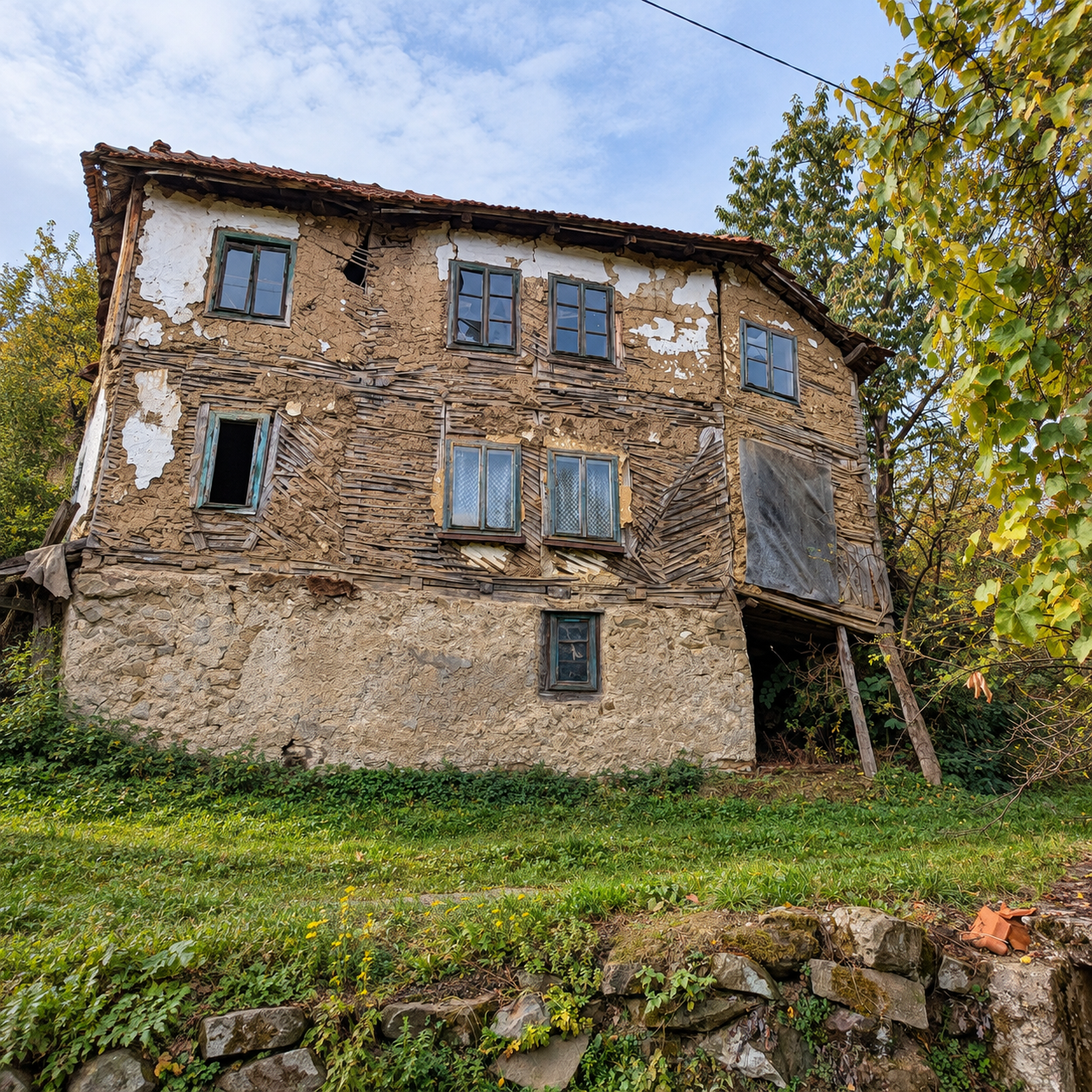
An abandoned house in the mountains above Zenica reveals the ingenuity, craftsmanship and everyday lives behind Bosnia's traditional rural architecture.
Sometimes, when I'm out walking in Bosnia and Herzegovina, something catches my eye that I would probably have walked straight past years ago.
Not a magnificent mountain view, although there are plenty of those. Not an ancient fortress or a famous historical monument.
Just an old house.
And recently, in the hills around Pepelari, above Zenica, I came across one that stopped me in my tracks.
It was a rather sad-looking building. Two storeys, a steep tiled roof, faded green window frames and a garden that nature was gradually reclaiming.
But what really caught my attention was the condition of its walls.
Large sections of the external plaster had fallen away, exposing an extraordinary network of wooden strips embedded in what appeared to be dried earth.
I took a photograph.
And later, looking at it more carefully, I began wondering how people in rural Bosnia had built their homes before concrete blocks, modern insulation and all the other materials we take for granted today.
What I discovered was fascinating.
A Traditional Bosnian House Built from the Land
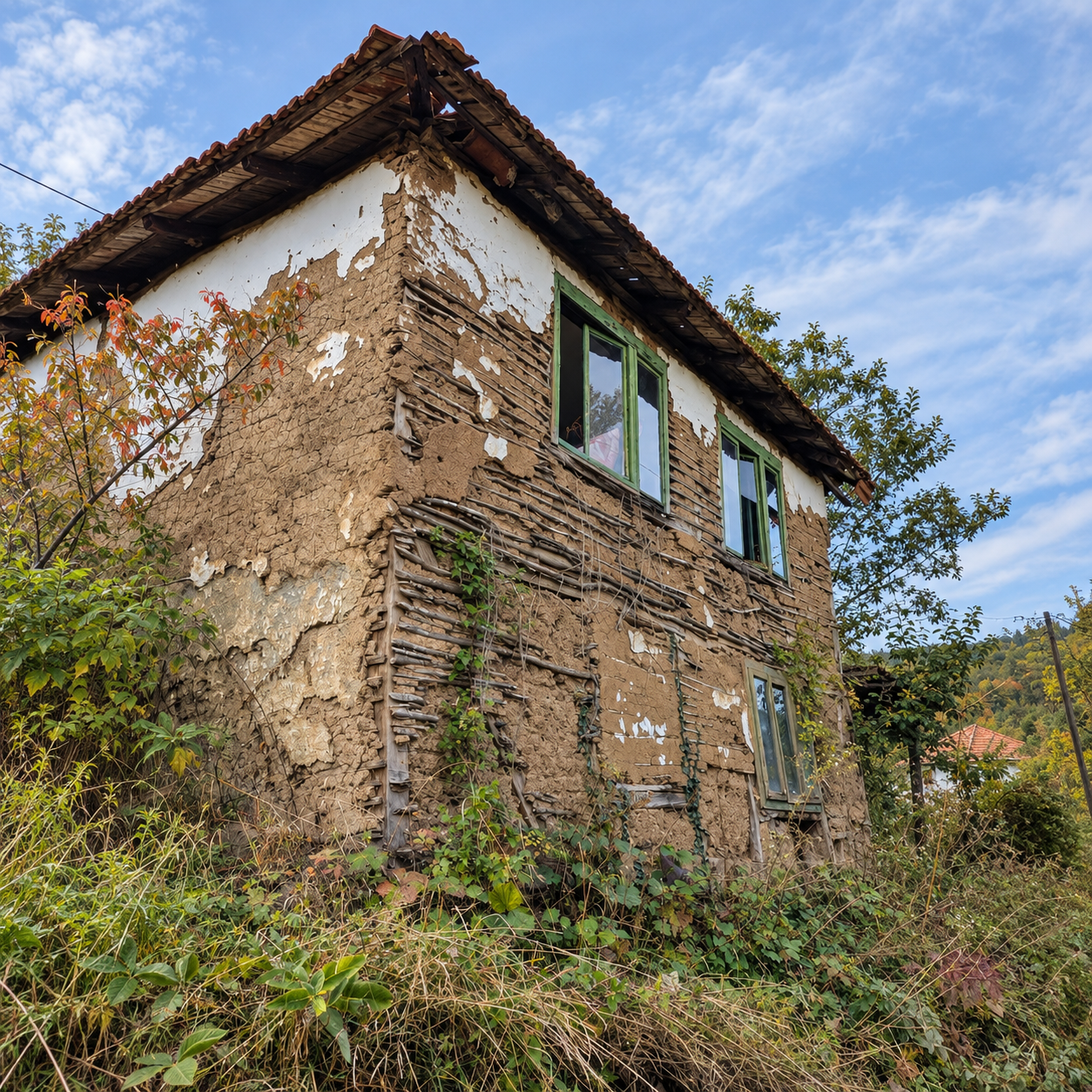
The construction visible in my photograph appears consistent with a traditional method known locally as čatma, often associated with a timber-framed building system called bondruk.
Houses using this type of construction are sometimes referred to as čatmare.
These methods were widely used across Bosnia and Herzegovina and other parts of the Balkans, particularly where timber and suitable earth were readily available.
The basic principle was straightforward.
Builders created a structural framework using wooden posts and beams. The spaces between the larger timbers were then filled or covered with smaller wooden pieces, sometimes split laths or woven branches.
An earthen mixture was applied to this framework to form the walls.
It was a practical approach to building, making use of materials that could often be obtained close to home.
But straightforward doesn't mean unsophisticated.
Constructing a durable house this way required knowledge, experience and considerable skill.
Why Were Wood, Clay and Straw Used?
Imagine living in a rural Bosnian village a century or more ago.
There wasn't a builders' merchant down the road where you could order everything for a new house.
Instead, people relied heavily on what their surroundings provided.
Forests supplied timber. Suitable local soil provided clay-rich earth. Straw and other agricultural materials could be used to strengthen the earthen mixture.
Depending on local practice, builders might also incorporate chopped plant fibres or animal dung into the plaster.
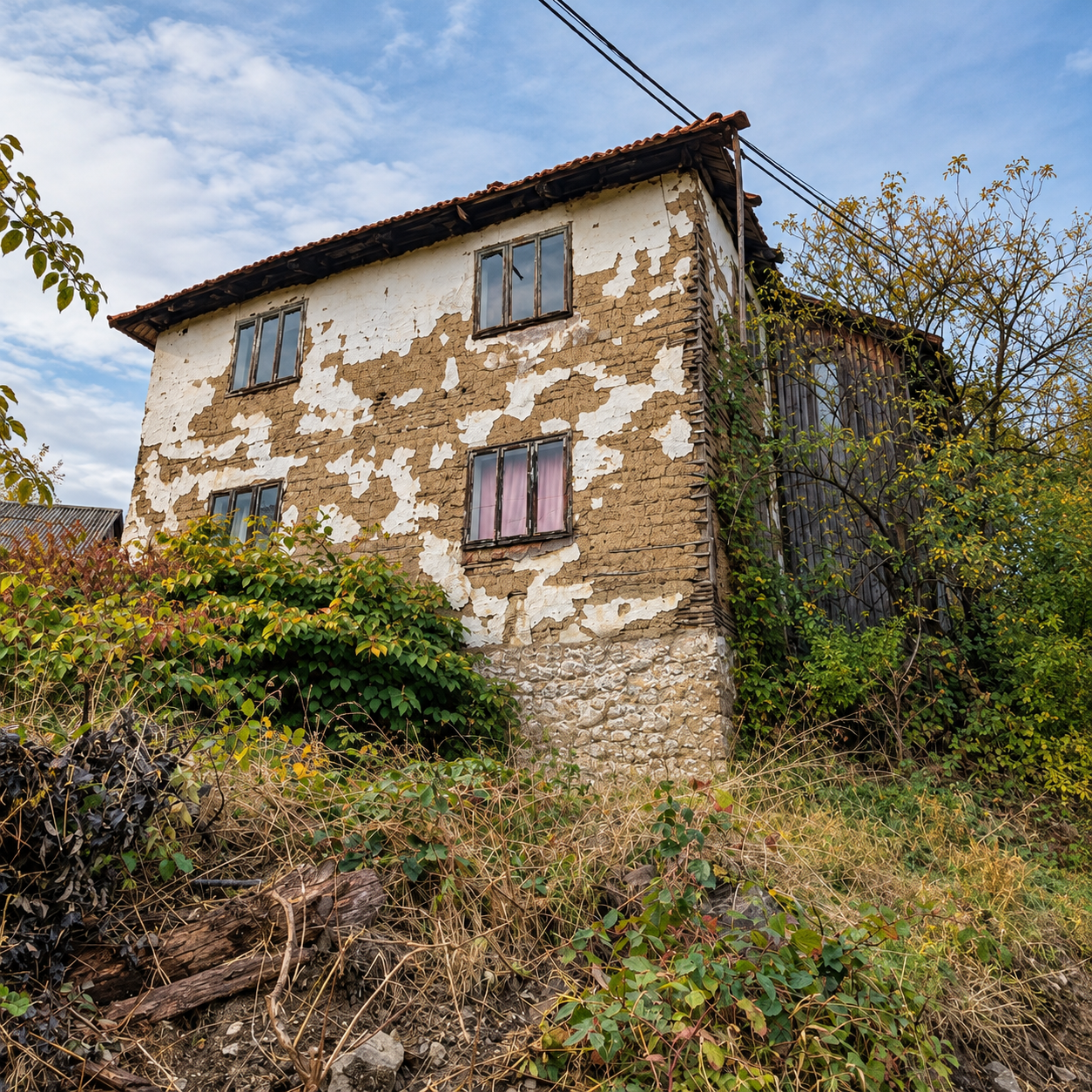
The wooden framework provided support, while the earthen material filled the spaces and helped create a solid wall.
Once properly dried, the surface could be finished with plaster or whitewash.
One advantage of these walls was their ability to absorb and release moisture. The earth also provided thermal mass, helping moderate changes in indoor temperature.
Of course, these houses weren't magically warm in winter or cool in summer. Their comfort depended on wall thickness, heating, ventilation and the quality of construction.
But they were carefully adapted to the materials and conditions of the region.
And perhaps most importantly, they were repairable.
Damaged plaster could be replaced. Timber could be repaired. Families could maintain their homes using familiar materials and traditional skills.
Why Did Traditional Bosnian Houses Have Large Roofs?
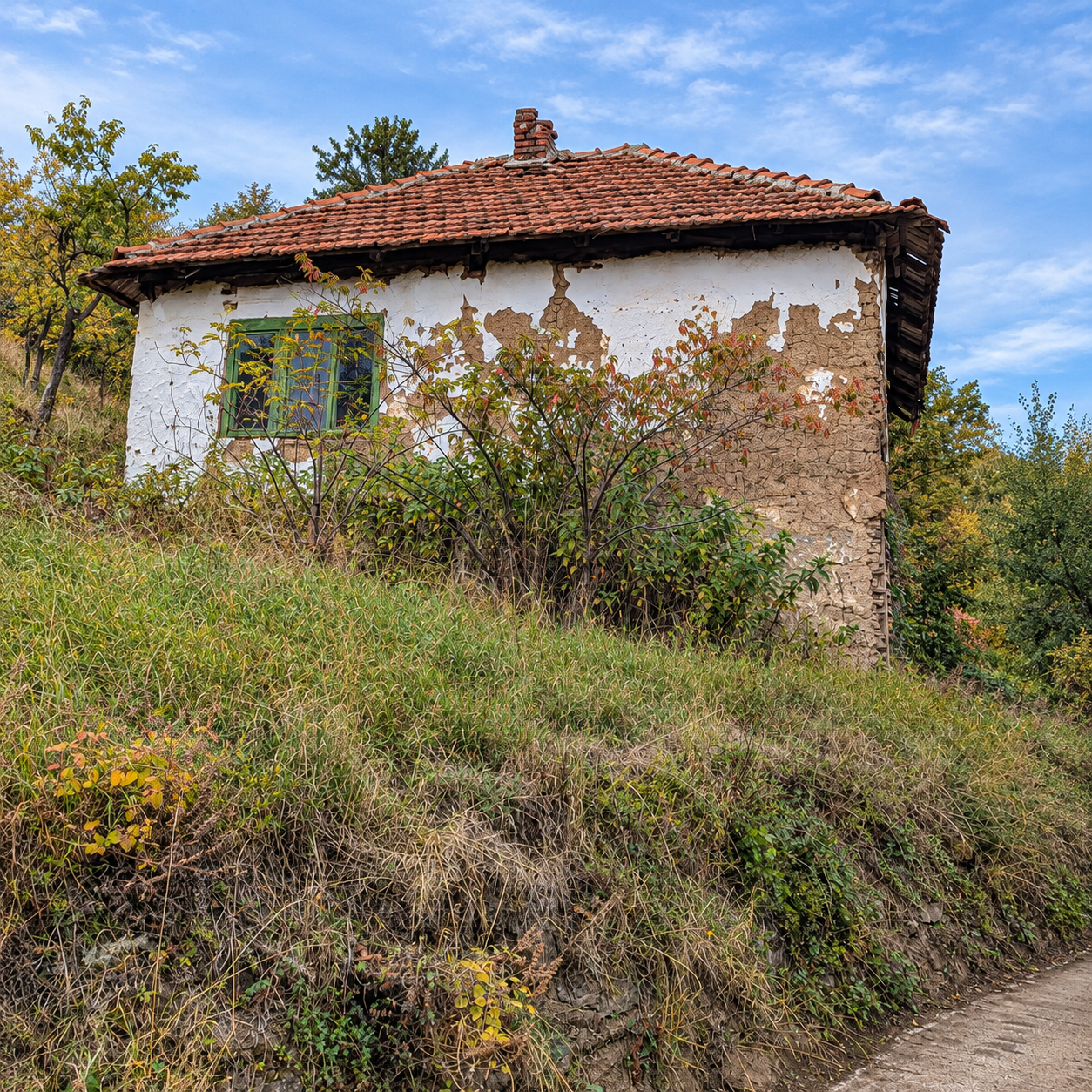
One of the details I noticed in Pepelari was the substantial roof overhang.
It extended well beyond the walls.
At first, you might think this was simply an architectural preference.
But there was a very practical reason.
Earthen walls need protection from prolonged exposure to rain.
A generous roof overhang helps prevent water from running directly down the outside of the building, reducing the risk of erosion and moisture damage.
The steep roof also helps shed rain and snow, particularly important in Bosnia's mountainous regions.
Traditional builders understood that keeping water away from the walls was essential to the survival of the house.
Looking at the damaged roof of the building I photographed, I couldn't help thinking that once the roof began to fail, deterioration of the walls would probably have accelerated.
In houses like these, the roof really is the first line of defence.
The Craftsmanship Hidden Beneath the Plaster
What I find particularly interesting about this house is that its deterioration has exposed something normally hidden.
The craftsmanship.
Look closely at the wooden strips running across the walls.
They're not perfectly uniform.
Some appear thicker than others. Some look like pieces of timber that were simply shaped to do the job.
And that tells us something about the building traditions of the time.
People worked with the materials they had.
A skilled builder would understand which timber was suitable, how to arrange the framework, how to prepare the earthen mixture and how to protect the finished walls.
Much of that knowledge would have been passed from one generation to another.
Not necessarily through formal training or written instructions, but through experience.
Watching an older relative or craftsman.
Helping with repairs.
Learning how things worked.
And eventually building something yourself.
There's something rather wonderful about that.
What we now call traditional architecture was, for the people living here, simply the way houses were built.
How Old Are Houses Like This in Bosnia?
That's a question I would love to answer about the house in Pepelari.
Unfortunately, a photograph alone cannot tell us its age.
Timber-frame and earthen construction have a long history in Bosnia, including during the Ottoman period, and continued to be used in rural areas into the twentieth century.
Some surviving houses may be well over a century old. Others are considerably younger.
Construction methods also varied between regions, villages and individual builders.
So I wouldn't want to suggest that this particular house dates from the Ottoman era, or even the nineteenth century, without some actual evidence.
It might be much younger than its appearance suggests.
But regardless of its age, it represents a building tradition that is becoming increasingly difficult to see in its original form.
What Happens to Bosnia's Abandoned Rural Houses?
Living in Bosnia for more than twenty-five years, I've seen plenty of changes in the countryside.
New houses appear alongside older ones.
Families move into towns.
Younger generations leave villages, sometimes for work elsewhere in Bosnia, sometimes for Germany, Austria, Slovenia or further afield.
And occasionally an old family home is simply left standing.
The roof starts leaking.
The plaster begins falling away.
Vegetation creeps into the garden.
Eventually, unless somebody intervenes, nature takes over.
I don't know what happened to the family who once lived in the Pepelari house.
Perhaps they moved away. Perhaps a newer home was built nearby. Perhaps the property is still owned by descendants who simply haven't had the opportunity to restore it.
It would be unfair to speculate.
But the building does raise a wider question.
How much of Bosnia's traditional rural architecture are we losing without really noticing?
And could more of these houses be preserved?
Not necessarily as museums or tourist attractions.
Perhaps simply as homes again, carefully restored using appropriate materials and techniques.
Of course, that costs money, and restoring an old earthen house properly isn't necessarily easy.
But these buildings are part of the country's cultural heritage, even when they're modest family homes rather than grand monuments.
More Than Just an Old House
There's another aspect to all this that I find quite moving.
When I look at the photograph, I don't just see an old construction technique.
I wonder about the people.
Who built this house?
Who chose those green window frames?
Was there a large family living inside?
Did children play in the garden?
Was there a wood-burning stove keeping everyone warm during those long Bosnian winters?
How many meals were prepared there?
How many conversations took place around the kitchen table?
And how many times did somebody stand at one of those upstairs windows looking out across the mountains?
We tend to think of history in terms of important people, wars, political events and dates.
But ordinary homes tell another kind of history.
The history of everyday life.
Of families, work, celebrations, difficulties and all those little moments that rarely find their way into history books.
A Different Way of Looking at Rural Bosnia
I'm glad I stopped to photograph that old house.
Because what initially appeared to be a crumbling building turned into a small journey of discovery.
I learned something about traditional Bosnian construction.
I began to appreciate the ingenuity of the people who built these houses.
And I found myself thinking about the lives that unfolded inside them.
I suppose that's one of the things I enjoy most about living here.
Even after all these years, Bosnia still manages to surprise me.
Sometimes through its spectacular landscapes.
Sometimes through the warmth of the people I meet.
And sometimes through something as ordinary as an old house on a hillside.
The next time you're travelling through rural Bosnia, perhaps take a closer look at some of the older buildings.
You might notice a deep roof overhang, an old wooden beam, or a section of exposed wall where the plaster has fallen away.
And perhaps, like me, you'll find yourself wondering about the people who built it.
Because sometimes the most interesting stories aren't found in museums.
They're quietly waiting beside a village road.